It was a classic case of “You Can’t Get There From Here.” We were picking up our daughter from a mountainside retreat, and figured we could include a detour to another foothill town while we were in this part of the state. We had mapquested our route, but had been irked to see the required path included a half-hour backtrack along the main north-south highway to the junction with the main east-west highway before we could continue on our way. There had to be a more direct route!
Fine. We’ll just ask one of the local people at the retreat house when we get there. No sense wasting all that time with such an indirect route. Unless....
The route on paper looked a little flatter than it did when our rubber met their road. There was this little matter of a few hills in the way. “As the crow flies” only works for crows.
I’m afraid the same hindrance works its way into a lot of paperwork for planning. Especially the plans involving our family’s so-called three-year challenge. At one point, I had been awakened to the fact—at that time, in three years—we would be moving from our usual life and routine to some very different possibilities. Those possibilities looked so huge, I felt the great need to get started then, planning for the next step. So what if it was only another step; from that vantage point, it looked like a massive one!
And, as time always does, it passes and leaves us wishing for still more of it to catch up with what is left undone. So, here I am, facing the end of my homeschooling career with my daughter’s high school graduation only two months away. While I am concerned for her and what she is going to do with the rest of her life, I panic when I realize I have no plans in place for what I’m going to do with the rest of my life!
Being the designated navigator for many trips, I’m used to planning routes. When going from start to finish, pick a line (a road) that most directly connects Point A with Point B. It’s that simple. That’s what we call efficient planning.
When it comes to applying this technique to real life, especially something so personal as applying it to my bumpy life, the efficiency becomes more dull, uninteresting—wait a minute, who am I fooling here?—threatening. There are mountains hidden in between these here points, these Points A and Points B. You don’t understand! Insurmountable challenges, risks, sabotages conspire against my better intentions. At least, there have been enough of these usurpers to fill up the allotted time frame. And then: failure. That is the risk when facing the demanding Efficiency taskmaster.
Zigzag has never made for efficiency. Heading in one direction, only to find out you must U-turn and head in another direction, is never the highest efficiency. But it may allow you to qualify for effectiveness. And that may be so, thanks to how our own brains work.
I was recently reading about the wonders of the mind, revealed now thanks to the gifts of technology. Several studies demonstrate that learning to play a musical instrument, of all impractical things, enhances brain function. A 1996 review by the College Entrance Examination Board showed that students with experience in musical performance scored higher on both the verbal and math sections of the SAT than the national average. One university study even claimed that music majors had the highest reading scores of any students on their campus. Several other analyses reported significant correlations between the number of years of instrumental music instruction and academic achievement in totally unrelated fields such as math, science, and language arts. In studying the undergraduate majors of applicants to medical school, one researcher found that 66 percent of music majors who applied to medical school were admitted. Those Point A To Point B plodders, the biochemistry majors? Only 44 percent made the cut.
In citing these and other studies of musicians, psychiatrist Daniel G. Amen observed in his book, Making a Good Brain Great:
The world’s top academic countries place a high value on music education. Hungary, the Netherlands, and Japan stand atop worldwide science achievement and have a strong commitment to music education. All three countries have required music training at the elementary and middle school levels, both instrumental and vocal, for several decades. The centrality of music education to learning in the top-ranked countries seems to contradict the United States’ focus on math, science, vocabulary, and technology.
So there is another way to get from Point A to Point B. The way to get there from here is not always a straight line, especially when we look up and discover the mountain in our way. The zig and zag of life may not be efficient, but can provide enrichment and insight. Perhaps that is why—yet only after the U-turn of hindsight—we can call it effective. But we can’t always call it planning.
Showing posts with label Stages of Life. Show all posts
Showing posts with label Stages of Life. Show all posts
Thursday, April 1, 2010

Thursday, December 3, 2009
Silence Still Speaks
 A blogging friend of mine complained recently about how she missed writing. There were so many things running through her head that she wanted to write about. So many things, in fact, that she needed to “get the words out of my head; it’s getting crowded in there and I need a pressure release valve.”
 True, writing can be a form of venting as well as an artful way to grant tangible shape to mental shadows. Sometimes, though, the shadows can be so murky that it is hard to coax them from the nether regions of mood into visible light. There are times when the flurry of life’s actions can produce an avalanche of words. Other times, events can turn and become the bottleneck damming that very flow.
It’s been four months since I last blogged. For some reason, though life kept moving forward at its usual warp speed, the words never assumed their own nascent presence—to break away and make any sound or take any shape of their own. Perhaps it’s that small matter of sound barrier. Or its equivalent in the realm of light. If there is a life barrier, is it possible to break it?
With all that has passed, how hard it has been to make myself sit down and write; how unusual for me to see myself saying this. I determined yesterday: tomorrow I will write.
Last time I wrote, it was a goodbye message for the one whose partner just joined him. Phone call, 4 a.m. I lose again all ability to put words on paper.
Tuesday, August 11, 2009
Putting in a Good Word

“Begin with the end in mind,” advised author Stephen R. Covey in The Seven Habits of Highly Effective People.
I don’t suppose Grandpa Don ever considered that advice—at least not when he considered smoking. That was when he was a kid. He had no idea it would get the best of him on the other end of life. But it did.
We made the long trip to the land’s end of
It happened during the eulogy. Eulogy: that’s a word you never hear until you are going to a funeral. Nobody seems to really know what it means—unless it means someone getting up in front of everyone to say nice things about a person (because it just isn’t fair to say mean things about people after they’ve died). In Grandpa Don’s case, the eulogy was said in an old country church that couldn’t have held more than thirty people—and even that would be a generous estimate.
In the simplest way that night, people came up and made their own contribution to a pot-luck eulogy. At first, it looked like the only ones speaking would be family members, then someone reading notes from grandkids who couldn’t make it. But bit by bit, neighbors got up to say their piece about remembering Don. A representative from his workplace—he was long retired but long-remembered—was there to say a public goodbye. And people from his church, even teenagers, told their favorite stories about him.
That’s when something happened. See, Don wasn’t really Dad to this family—he was Step-Dad. No matter how many good times were had when the family gathered, there was always the long shadow of the dad who really was Dad but only lived on in the childhood memories of those who were now adults. There was no replacing Dad. But that kept eyes from seeing who Don really was.
The turning point was the eulogy. Eulogy: from two Greek words, the one a handy prefix, the other a term that has been oft-appropriated by our own mother tongue. “Eu” was a sort of accelerator for the Greeks; when plugged into the beginning of another word, it intensified its status. It basically means “good.” The “-logy” is actually from the Greek “logos,” the same root that gives English-speakers their business logo or their philosophical logic. It is recognized by Christians as a significant term representing not only the literal meaning of “word” but also the intelligence behind it: God Himself. “In the beginning was the Word.”
Plugged together, the two components signify “to bless” or “to praise.”
Funerals are events that rank fairly low in most people’s list of preferred activities, so I can understand why people don’t often rub shoulders with concepts like “eulogy.” I can’t think of how many funerals I’ve attended that I didn’t really want to be at. I’m not talking about close family members’ funerals, but those of distant relatives or friends’ family members—events which I’ve attended not for the dead, but for their living. A solidarity thing. Standing with them in their pain.
There was one such funeral I had attended that stands out, though. It was for my neighbor’s mom. One evening after work, my neighbor had mentioned that his mother had unexpectedly passed away. Though sorrow in such a case is understandable, there was something so plaintive in the way he told us about it, my husband and I felt we should support him by being at his mom’s service. We really didn’t know her—had only met her once. But once her eulogy began, she became transformed in our minds, lifted up by the vibrations of the stories her family offered up in her praise. We left that funeral regretting having missed the opportunity to get to know someone so neat!
Somehow, the same thing happened this summer for Grandpa Don—for us. It is incredible to see a life taking shape solely through the words pieced together by people who care deeply for that person. The pity is that it is a life in retrospect. Oh, to know the person that way while he or she is still living…
It makes me wonder why we wait so long to acquiesce and admit that those we know—those closest to us, those we see the most often and the clearest in all their glaring faults—are really those neat, special people we make them out to be after they are gone. Why do we wait until they are gone? Why don’t we eulogize them when they are still living and can enjoy the love we show through our words?
Used to be, when someone was looking for one of those scarce jobs in tough times, a friend might help the process along by promising to “put in a good word” for him. Though a good (“eu”) word (“logos”) for a job hunter would never be called a eulogy, that is exactly what it is. There are all sorts of ways to bless the living with our good words. Why wait until people pass away to speak up?
Photograph courtesy of Christa Elza Photography
Wednesday, July 8, 2009
A Day I've Learned to Consider Carefully
Today: July 8. Twenty one years ago today, I lost my first husband to premature death. July 8, one year ago, an ultrasound revealed the growth that was later determined to be cancerous. Today, again July 8, my family flies halfway across the country to be with my father-in-law in what most likely will be his last days as he lingers in an intensive care unit in a Texas hospital. July 8 has become a day I am most familiar with, but most unwilling to participate in.
Monday, July 6, 2009
And I thought I'd have plenty to say about it
So it was cancer. But now it is all gone. They say.
I hope.
It’s been ten weeks, now, since the event. Ten weeks of opportunity for recuperation. Ten weeks of ample time for reflection—and yet, in all that time, no chance taken to simply sit down and write about it. How can that be so hard?
There is something stultifying about facing the threat of cancer. Why does it take away words? Even the least threatening of cases yields the same result. The mere threat of death is itself enough to suck words right out of the soul.
I had to make myself sit down and write. Ten weeks of saying nothing about what is at the core of my being right now is ridiculous. But don’t expect profound. These words resemble output of a grade school student forced to recount “What I Did During My Summer Vacation.”
If facing death can be one of the most critical tasks we endure, then why does it produce such a vacuum in response? When I think of life, I can think of all sorts of profound responses. When I stare at the brick wall of the end of life, I find no inspiration.
But the current, self-imposed task was to write about it. So I’m writing.
And having met my obligation, I'm moving on.
Friday, December 12, 2008
When It’s Too Late to Wait

Though ever the consummate procrastinator, I may this time have waited past the point of no return. I have had my many rounds of promising this or that when I get “A Round Tuit,” but my motto was never to be a spendthrift—even if what I was spending was the proverbial Tuit.
A month ago, I got my Tuit: biopsy showed cancer. Better hurry up and live while it still counted. I thought of all those must-do projects that lay in stacks in some by-passed corner. I thought of all the promises I had made myself, dreams that I wanted to fulfill, all but for the time still vibrant in my best of intentions. This announcement provided the Tuit, the time warning to get busy.
Did I? Of course not. Hard to break the habit now.
Even worse, had lots of difficulty facing up to facts, though I heartily deny that I’m in denial. Like rubbing a cat’s nose in its own unfortunate mess, I could barely shove my eyes-wide-open face into the new facts of my life. So, of course, the safest approach was to…procrastinate.
But now, on my way to see the second specialist, on my way to actually set the date for my point of no return, there really isn’t much time to play. If there’s ever anything worth doing, now is the time to do it.
I’ve heard people remind others that we all have a death sentence on our heads. Usually, I hear that at funerals, and when we all get out in the daylight and chrysanthemum-free air, it’s so much easier to forget that fact. But it’s true; it’s just that we never think of it in those terms.
Though dismal, the reality of that idea can turn out to be a blessing. What focus! What super-charging of the ol’ Daytimer! It’s an idea that can provide power. Motivation.
Or just burn-out. The spark that fries.
From my point of view on the fence right now, I tend to wobble in the direction of down. It’s not that uplifting, I know, but I think of all the things that I really would love to do that will probably never get done.
The price of procrastination, after all, was not really just a Round Tuit. You can’t pay the price until you spend the money.
Wednesday, November 26, 2008
When It’s Time to Go Home
Last night, our county’s Hospice program lit up the “Tree of Life” to start its annual fund raising season. Though we always enjoy seeing the lights when we drive by the tree at night, we don’t usually attend the ceremony.
This year was different. One of Claire’s best friends and also her former debate partner were chosen, along with their family, to light up the tree in honor of their mother, Susannah Kelley. Moms can die young, and Susannah, mother of four, did so this summer at age 48.
It seems she was not alone. This summer brought a series of losses to those we know. Barely a year or two ago, one of my husband’s mentors at work was diagnosed with pancreatic cancer. He was one of those men who was an exhorter—someone who supported novices with promise and pointed them toward reachable goals, and then followed through when times required diligence in the hard work of details and persistence. Though beaming encouragement to others until the very last days, he too was one we bid goodbye only a few months ago.
And there are more to come. Another work friend—someone who partnered with Chris through thick and thin of difficult assignments, someone we knew had an inoperable tumor that just seemed to hang fire in his brain—suddenly got the verdict: go home and rest. The tumor had resumed growing. He has anywhere from a month to a year remaining. And that’s it.
How do you handle news like that? It certainly was hard for his coworkers to hear about it. But what about being that person? How do you handle the news when it is about you?
Fortunately, for each of those we lost this year, faith played a strong part in their lives and in their passing. I have no clue how people could handle it otherwise. But even with faith, the passage is not effortless. With cancer, for instance, there is the drawn-out agony of pain and waiting, perhaps a sense of being deserted or of wondering, “Why?” There is also that languishing yet dogged hope of being rescued: that this will be the one time that the Lord chooses to perform that miracle healing.
It seems so hard, being on the healthy side of an encounter with someone in this position. What can be said? Do we speak of healing to be an encouragement? To avoid dragging the poor soul’s spirits down? Or does that cancer-ridden friend ache for the pretenses to be dropped and just allow freedom to say, “This is it,” without fear of being branded as faithless? What does a person who is slowly dying need to say?
I remember being party to the other side of the equation when my first husband was dying of complications from heart surgery. He was young; no one believed he was seriously in risk of dying until the moment was nearly upon him. Not a word was exchanged about that possibility. Once he slipped into a coma, though, I became his proxy, his mouthpiece. People were so kind, so nice…but it was such a comfort to be free to jump the track from scripted orthodoxy to plaintive stream of consciousness. The jibberish of feelings may seem useless, but without saying something, how are the others to know how to break the silence, cross beyond the fear of stigma or taboo, and speak the words of life to the desperate dying?
I have never known the nearness of death (although I have thought I did at times), but somehow I wonder what would be the best ministry to those in whose place I’ve never been, when that place is near death. I’ll never be able to know without asking—and how do you ask someone in that place, when that person may not be able to face up to that reality themselves, right now?
Susannah was one who was in that place, and I never took the time to ask, to learn from her what she saw as the biggest need. I did observe one thing: she seemed to have died with a smile on her face. If that was what God had required of her life, that was what she was willing to do in her service to Him. Many do handle this turning point with philosophical reflections of returning to one’s maker, or of going to a better place—but rarely does one express the willingness to go through the process that brings us to that other place. It takes a servant’s spirit, a yieldedness, to submit to the risks of that ordeal. When Susannah realized it was time for her to “go home,” she took hold of the grace given to see us through whatever turmoil we face, and discipled herself to her spiritual mentors.
When I was a child, summertime twilight calls from my mother, “Time to come home,” were both times of protest and times of realizing good possibilities. Playtime couldn’t possibly last as well after dark—besides, there would be another day—and once home, a comforting bath and story time awaited me. Realizing the fleeting playtime I was leaving behind was insignificant in the face of the cozy comforts yet to come, it wasn’t all that hard to go home when the time came.
Wednesday, August 20, 2008
The Gap
 In a society that values goal-oriented, time-managed living, one of the most fearsome circumstances to find ourselves in is The Place Between—between projects, between assignments, between jobs. A professor once mentioned to me that, soon after students receive their research assignments, they experience the stage of “milling about,” an aimless, listless time before the “Aha!” light bulb ignites to lift imagination out of the doldrums. Without the energy of discovery propelling us forward, The Place Between, the place of The Gap—that undefined element—can risk morphing into the mind’s bottomless pit.
While our natural tendency is to shun gaps, face it: gaps are where the action really happens. On the surface, The Place Between may suggest a listless existence, but under the placid surface, multiple possibilities are churning, strands of thought flying off in every direction.
A gap can be the space between two points where energy flows from the negatively-charged bottom of the clouds to the positively-charged segment of earth about to receive a brilliant lightning strike. It mimics that miniscule cleft between two communicating links in the nervous system that provides our bodies the ability to function in miraculous ways. In short, The Gap becomes the frontier between what we’re leaving behind and the possibilities we hope to achieve. That frontier is where the action whips up.
How scary can that be?
A gap can be an icon of connectivity…or at least the potential of relationship. The uncertainty really becomes what we make of it. And it’s driven by what we understand of the Point we’ve left behind, and what we perceive of the Point we hope to find.
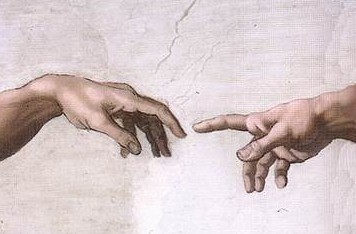
In one of the most poignant visual representations of the crucial aspect of The Gap, Michelangelo encapsulated the whole of the relationship potential between God and Man in one simple gesture. In the artist’s Sistine Chapel ceiling fresco, “Creation of Adam,” the now-famous space between the finger of Adam and the finger of God holds the captivating potential of mystery. Why aren’t the fingers touching? What is going on in the in-between place?
Connectivity sometimes puzzles me. Two people can have a relationship—can even be in the same room—yet be in completely different worlds. We can reach out and touch somebody, but did we really connect? What allows the connection to take hold?
The other day, Chris and I went to the hospital to visit a fellow homeschooling mom who suddenly and seriously found herself engulfed with cancer. She looked so different, so small, lying on the bed in her darkened room, undergoing chemo as we spoke. The pain of nights without sleep showed in the deep blues encircling her eyes. We came there, theoretically, to pray for her and encourage her. But can any of those mere words uttered make the connection that matters? She was in a bed not two steps away from me, but even if I reached to take her hand, could I really bridge The Gap? The Point A vignettes I knew her in for so many years now gave way to a gap between the Nice-Life known and an unknown Point B. How does one really speak to Point B when one hasn’t yet negotiated The Gap?
Crossing The Gap means making a difference. The Gap is outlined by Point A, sometimes also by Point B—but we can never, really, actually define The Gap as we move into it. We can point it out, demonstrate it, feel real feelings as we cross it, but we can’t explain the frontier. If we could, it would stop being a frontier. We would then have made the difference, have converted the potential into the knowable. Until it is known, it is fearsome. It represents a crisis, yet, it becomes our challenge.
What to make of The Gap?
Subscribe to:
Posts (Atom)
