Showing posts with label NeedToConnect. Show all posts

Tuesday, March 8, 2011

Pivot Point

It is only half the story to say that the power of books is through their doorway to the Great Conversation with the past. The real impact will only be seen in what we have to say to the future.

It takes faith to talk to the future. We don’t know that there even will be one. Yet, from one devastating epoch in treacherous history to another, there have thankfully been those who have had the faith that time would still move on—that there would be someone at the receiving end to talk to.

From one of those tumultuous past eras comes a vignette I’ve often pondered. It is from the life of Jane Lucretia D’Esterre. One of those stories that you just have to stumble upon, hers was one I found deep in the middle of a book I was reading about something else.

How can any romantic resist the pathos of a story that begins, “Jane Lucretia first heard of the duel that shattered her life when friends carried her dying husband into the house.”

There is every reason to be gripped by the story. The young woman—vivacious, talented, beautiful—is just the one to win hearts. Married to a man with a promising political future, she is the mother of two young children. Circumstances, however, rip her away from the contentedness of the good life.

“The year was 1815, the time of Wellington’s victory over Napoleon at Waterloo. Dueling was still legal....”

“Devastated” was not an adequate word to describe this woman’s reaction to events. She fled her country to the north, finding safe haven physically, but not emotionally. Her tragedy brings her to the brink of attempting suicide. But for what might have seemed mere happenstance, she would have taken that step. Somehow, she snapped back to her senses, returned home, and resumed life.

Life, though, was now different. She had found the Lord. Things didn’t change immediately, but in that imperceptible way that it often does, healing took place. A few years later, she met and married a man whose surname many will recognize: Captain John Grattan Guinness, youngest son of Dublin brewer Arthur Guinness.

The story isn’t yet over. In the telling of it by her great-great-grandson Os Guinness in his book, The Call: Finding and Fulfilling the Central Purpose of Your Life, he describes her as “unusual for several reasons.” He explains that she “conscientiously prayed for her descendants down through a dozen generations.”

But Dr. Guinness is only her great-great-grandson. That means there are eight generations still to come. Her prayer is yet to be fully answered. That’s the measure of one woman’s faith.

The trajectory of my faith—or yours—may not be as remarkable. After all, these are tumultuous times. There is one thing to keep in mind, however: the beginning of the trajectory marked the pivot point from past to future. It takes a decisive action to turn our attention from our heritage—receiving it, benefiting from it, enjoying it—to our legacy. It takes work to pass something on.

We are the pivot points between the turbulence of the past and the possibilities of the future. We carry the faith forward when our actions show our trust that our work will bring some good to light for those yet to come.

It takes faith to believe in a future. But if we don’t work for that future, too, our trajectory will be very short, indeed. While faith without works may be dead, works without faith are near impossible. As much as those of the past have spoken to us in the Great Conversation of our heritage, we need to speak to those who are yet to come.

Thursday, March 26, 2009

Becoming Famous Despite Shrinking Social Distances

I thought, today, about the irony of an actor applying make-up to the face of an amateur attempting to portray an actor—an Escheresque thought to twist my mind while spending the day alone. Following close in the footsteps of her dad, our darling daughter was plying her newly-learned skill as make-up artist at a local “Every 15 Minutes” event. Due to unexplainable logistics problems, today she felt the need to have a friend accompany her and provide assistance.


That friend happens to be an actor. If you ask him, I’m sure that is what he would affirm. He has spent innumerable hours considering the craft. He has paid his dues in the required local amateur events, served for wages little higher than sheer gratitude in experimental attempts to break into the market, and actually succeeded in making his face stick to product that has seen the light of day.


The event they were assisting this morning required the early-morning painting of over two dozen high school faces in the macabre shades of death. This was all in preparation for a mock car wreck staged for the benefit of the pre-prom student body—a grim reminder of possibilities each student’s parents would rather not face. Some of the students, standing in as “actors” in the scene, would be made up to look like victims of specific injuries—all designed biologically-precisely by an attendant emergency-room nurse supervisor. Claire and her new-for-today assistant were tasked with bringing those hospital-exacting schemata to life.


I could just hear the backroom chatter now. The creator of the morbid moulage, coaxing his palette’s plaster onto the site of the student actor’s wound, somehow letting slip that he happened to be an actor…for real. What impact in conversation that ensued?


When I was little, I knew the magnetic pull a comment like that could make. I happened to grow up being the kid sister of an actor. On the rare occasion when he came to my home to visit, every school-mate of mine for a multi-mile radius somehow heard the news and flocked to my front yard. I’m not sure what they expected when they got there. I’m not even sure they knew what they expected. But this was someone “famous” and that is what is supposed to be done when someone famous happens by.


That, however, was when there was one source of daily entertainment—one television, with three predictable stations, that offered itself as near-sole provider of entertainment to an entire population. If you saw it on TV, chances were that everyone saw the same thing. And people who were seen on a screen like that became, by definition, famous.


So, if famous means everyone knows who you are, what is happening to famous today?


In the current iteration of the niche-marketing mantra, the plethora of entertainment products makes the star of one DVD a nobody in everyone else’s world. And that is just looking at today’s world. Add the digital capability of reviving one’s favorite entities of times past, and even today’s stars get buried.


Wired’s Chris Anderson analyzes the economic imperative of yesterday’s blockbuster in his book, The Long Tail,and concludes it is the digital prowess of today’s technology that both annihilates the economic necessity of hit-driven stardom and enables the esoteric candy-shop environment where both the hits and flops of years gone by are still on the shelf. Old or new—if you know where to look, now you can find almost anything you’ve always meant to buy. “Don’t step on that dwarf—hand me the pliers!” may not be a winner on today’s sales charts—may never have been when it was new—but in the aggregate, generates enough sales to justify its current “for sale” sign.


In addition, it used to be a significant find to discover that one’s friend or acquaintance was a relative of someone famous. Does it seem that almost anyone is related to a famous person nowadays? Or is this just a shrinking world? The famous series of “Small World” experiments conducted by psychologist Stanley Milgram at Harvard in 1967 sought to answer the question: What is the possibility that two randomly-selected people would know each other? With an ever-increasingly connected world, the path linking two total strangers seems to be shrinking. That “social distance” makes random connections more likely, stand-out anomalies less likely.


Obscured in the lateral breadth of product, buried in the vertical crush of historic variety, shrink-wrapped in diminishing social distances—what’s a star to do?


Assuming that humble, toothy stance of “yeah…yeah, I’m an actor” may not ignite such a reaction now, thanks to our post-modern world.

Tuesday, March 24, 2009

Creating the Tools That Shape Us

I’ve been fighting to win at the game of catch-up when it comes to sleep. We’ve been away at another debate tournament, this time enjoying the peacefulness of the University of San Diego campus.

Tournaments have this one unwritten requirement that all participants (student competitor and adult parent-judge alike) must be able to thrive on less than enough sleep. Whether powered by sheer adrenaline or other more mundane substances like caffeine, the participant must be able to attend to proceedings for more hours in each day than should be humanly possible.

So the other day, when I finally had a chance to regain my pre-exhaustion equilibrium, I was somewhat annoyed that that opportunity was interrupted because my now-out-of-town husband had neglected to turn off his alarm clock. Thankfully, it was set for the more merciful weekend wake-up routine rather than his brutal workweek setting. That, however, meant I was now conscious enough to comprehend what his talk-radio squawk box announcer was saying before I flipped the switch—hence exposing me to an ear-worm that kept me from my morning’s intended purpose.

The announcer was giving a run-down of the various communications devices made available in recent years. I’m sure he was headed for the virtues of the newer social media at the point I pulled the plug. The part that stuck in my head, though, was his analysis of email: “the clunkiness of email.”

Clunkiness! As if email were no longer a viable tool, useless owing to its antiquated format. The thought was just incredible to me. Do you know how useful email is?! How it has streamlined not only communications in general, but work in particular? And that is “clunky”?

What would be next on his list of communications improvements? MySpace or Facebook, assuredly, would find a place. Twitter most certainly, honing the communications space even further. The task, it seems, in avoiding clunkiness in communication is to polish the skill of saying more in less space.

Fine. You can have your 140-character parameter. But there is only so much you can write on a postage stamp. I know I’ve already ranted about the fact that there isn’t much that can be said, beside weather report or dinner plans, in so short a space. What I’m concerned with now is the impact that thinking—and communicating those thoughts—in such short phrases might have on us as people.

It seems we rarely give thought to how the world we create is actually shaping us, its creators. In the campus buildings I spent last my last week at, however, the architecture made no secret about how it shaped us. This was a private college campus with Catholic roots. Its builders seemed to instill the virtues of the faith even in the walls that housed the people, both believers and non-believers, so that a reverent hush and saintliness descended on all visiting there. That, by the way, is no mere figure of speech. It was incredible to see people walk into a building, and—by the sheer shape and acoustical characteristics of the building—immediately assume the humble position of whisperer.

There is an artist that, earlier in the 20th century, perfected the technique of twisting the observer’s mind by drawing “up” as if it were “down.” M. C. Escher’s “Relativity” is the well-known 1953 lithograph print depicting staircases that seem to ascend if viewed in one direction, descend if seen from a different perspective.

Earlier in his career, Escher produced a lithograph, “Drawing Hands,” showing a hand drawing a hand which was (predictably in Escher fashion) drawing the first hand.

“Drawing Hands” has become the visual icon, in my mind, of what we are doing to our verbal selves when we hamper our abilities to connect interpersonally under the guise of honing our communication skills. We don’t realize the impact our self-imposed limitations have on our own out-reaching minds.

There is no doubt that friends, visiting with friends in Charles Dickens’ England, would take quite a bit longer to finish their sentences than friends hanging at today’s mall or coffee shop might take. However, I wonder at the possibility that today’s conversation might be no more verbose than the proverbial cave man’s might be. We chop, whittle, and discard all the “extraneous” words to be concise…and also suck out all the flavor, freeze-dry the content, and UPC barcode the synopsis as time-saving devices so we can do more.

More what?

The exercise of taking time to express one’s self represents not only the contents of what the speaker or writer is saying, but the process of developing the thought behind it. While this is not always true, saying more may very well mean thinking more. At least it puts a person in the position of feeling the need to do so.

If all we are required, in our “modern” society, is the ability to say something in 140 characters, we will either be elevated to the status of master haiku creators, or reduced to the off-the-cuff redundancy of driveling rehashers of the weather and dinnertime repasts. If we vacuum-pack our contents, what does that say of the brains required to produce that content? Most people are simply not up to that challenge. As far as I’ve seen, the smaller the container, the skimpier the content.

Twitter? For clunkiness, I prefer War and Peace. But I’ll take email any day.

Wednesday, February 25, 2009

Drop in an Ocean of People

Anyone who recognizes the acronym RAOK knows how futile it seems for one person to effect change among billions—and how positive some people are that such change can start with one act. To me, that one act seems to resemble the proverbial drop in the ocean, but to RAOK enthusiasts, it is the first step in getting the ball rolling.

RAOK believers do things like tell the toll booth attendant, “Here’s enough money for my toll—and keep the extra to pay for the driver behind me, too,” then drive off, serenely confident that they have made the world a better place. (Meanwhile, the driver behind zooms to catch up, swerving dangerously in front of oncoming traffic in a vain attempt to see who did such a crazy thing.)

I’m in Houston now. While my Houston-bred husband is properly impressed with the current size of the city he ditched 20 years ago, my New York Metro roots still balk at calling this “immensity.” The head count is diffused over a wide, non-descript plain of people. Even so, it is enough people to make me wonder whether any of them could be convinced to line up, just so, to replicate the domino effect.

Chris (said Texas-boy husband) has for many years made it his habit, when we travel, to initiate one of those drops in the ocean of people. He picked up this idea from a speaker at a homeschool conference: take a candy bar, add a simple message of gratitude, and pass it to anyone helping us on our trip. With a computer-printed label slapped on a Hershey bar, he is armed to distribute gratitude to bus drivers, skycaps, and airline flight crews.

His message, following a big, colorful “Thank You,” states: “When you are away from home, it is nice to know the people you trust for your comfort, safety and well-being are professionals who are dedicated to their jobs and the people they serve. God bless you for what you do every day!” Underneath, he inserts the name of each one of our family members.

Simple, huh?

What happens next gets completely complicated. It must have to do with the psychological underpinnings all we mortals carry around, invisible, underneath our pasty, face-masked exteriors. We’ve seen airline attendants, particularly, wax eloquent, brag about us incessantly over the intercom system, flock en masse to the row where we’re seated to personally express profuse gratitude.

It all had started getting overwhelming for me. I have a difficult time with my personal radar, determining sincerity from strangers, so my cynical self felt over-modulated at times in past encounters. When one attendant, a few years ago, came up to pass us a hand-written note—and evidently had tears in her eyes—I began to wonder. Some others confessed to us that they had just completed one leg of their journey which included a particularly intractable personality, and that they “really needed this.” It made me begin to wonder about the working conditions of these airline attendants—about the people these professionals are paid to encounter in their line of work every day.

But this trip took the prize. After completing what now is our customary travel ritual, we looked up at our seats to see three attendants beaming their thanks down at us. Nothing unusual here…until one attendant said, “In all my 16 years of flying, I have never had anyone thank me for what I do in this way.”

Anyone?

Anyone?

It got me to thinking about all the people we encounter in our everyday life: the toll-takers, the coffee-makers, the ticket punchers, the floor-sweepers. Anyone? Anyone thanking them?

More than that, anyone recognizing them as real people? I always have tried to make the bubble-break buffer zone in the midst of the time-squeeze routine of normal stuff like ordering coffee to say, “How are you?” and mean it. Mean it, because that person is a real person with a job that forces the rest of us to treat him or her like an extension of a machine rather than a real, flesh and blood copy of the same stuff that went into making us. How incredible that we can become so busy that we can’t take the time—by our actions—to remember that.

And so, RAOK—random acts of kindness—may indeed be the salve needed to bring people back from the brink of morphing into machines. Our business environment pays tribute to bosses who recognize their employees or professionals who affirm their clients—but what about customers who appreciate the service they receive in the countless ways we’ve come to expect in our typical work day? Yes, it’s their job, but isn’t it handled a bit nicer when it’s a person performing the duties?

I’d say 16 years is too long a time to let our free-market service professionals go unthanked. We could all use adding a couple words to our vocabulary and dispensing them liberally: “Thank you” for a job well done.

I’m looking forward to a glimpse of the domino effect resulting from the first barista keeling over in shock of some long-owed appreciation. This is a people-wave we could all look forward to surfing.

Tuesday, January 6, 2009

Word. Economy.

Spoiler alert: this entry will include another Twitter rant.

There seems to be, with the eruption of multiplied sources of word content, a coincidental and inverse action upon the sources of value content. While the word count goes up, the dollar count seems to go down. The more the world talks, the less economic value the world seems to enjoy.

On the one hand, we have escalated from mechanical typewriter to IBM Selectric to word processor to personal computer to fax and cell phone to Blackberry to…well, you get the idea. In the meantime, the more we Twitter, the less we produce. Sometimes, I wonder at the negative covariance of the two trends.

There are many who will argue I’ve got it wrong. The fact that we can fling words from one corner of the world to another in nanoseconds is sheer proof that we don’t have to wait, anymore, to finish our assigned tasks. That alone, Boss, should qualify for the Worker’s Nobel Peace Prize.

Words even have leverage now. What I used to key into a device to text a friend now can be broadcast, thanks to Twitter, to multiplied anyones who care to know my mundane daily musings.

There is something diametrically in opposition to the fluff of multiplied communications, and that is the pre-requisite of productivity.

I remember working on a genealogy project years ago—something I’ve always enjoyed as a hobby—when I found an online group suited to tackling the particular research aspect I was stuck on at that moment. While I can’t even recall whether the group helped me unstick from my dilemma, I do remember someone commenting on the frustration of not being able to find genealogical answers in, say, those church records of the 1870s in Prussia. Someone else was kind enough to provide the reality checkpoint that people in past time frames might have been a little busy with something other than wondering who their great-great-grandparents were. Say, something like whether there would be enough food to take them through a particularly chilling winter season. Point being, when it takes all you have to give to get food on your table, you don’t spend a great deal of time expounding on the virtues and values of much besides what will get that food on your table. We, on the other hand, can dally in luxuries of little consequence. Our productivity requirements have amply been over-exceeded.

Today, we have all sorts of commentators spouting off all sorts of opinions, recycling and passing along all sorts of tidbits of information, which dutifully get tossed everywhere but on the trash-heap of internet forwards. Perhaps these talking heads (well, now we don’t even get to see the heads!) are paid well for their participation in the chain of communication. But they aren’t really producers.

And it is the true producers that provide the value in a society. At least at the bedrock foundational layer. If someone on the bottom weren’t doing the sustaining work that provides our needs—with plenty of profit to spare—none of us would enjoy that spendy gift of gab. That bedrock productivity fuels our divergence into the countless iterations of thought—or thoughtlessness—that we enjoy.

There is a phrase I found once in an ancient writer’s work which has stuck with me, concerning the point at which value is actually created. It from a warning by the revered Hebrew prophet, Moses, who was reminding his people that, though they became wealthy and felt self-sufficient, they still needed to remember the source of their abilities. The concept I bought from that passage was “the power to produce wealth.”

I took a look at the original language (with lots of help from reference books) and isolated three key words.

The Hebrew word for “Power” came from a root word meaning “to be firm.” It had the idea of vigor or force, the connotation of a capacity or means to produce.

“To produce” was from a root word meaning to work, labor, or toil, and gave the sense of making, creating—especially building or constructing something. It often was linked with a sense of ethical obligation. Over the years, it came to be understood generally as “to do” or “to make,” but the creative implication was not lost on me.

“Wealth,” however, was the most interesting in this emphasis on creation. It originated from a verb whose two main ideas were spinning, and twisting—as in labor pains before giving birth. To bear a child, to be strong: those were the main messages of this word’s history. From this sense of causing to bring forth, word usage evolved to include concepts of multiplication: “army,” “strength” and “wealth.” Once again, it involved something tangible, and something which required strong effort to produce. And it yielded something of value.

The take-home message from Moses’ lesson for his followers was: Don’t forget the one who gave you your ability. Today, that message reminds me that true wealth comes from creative, productive effort—the hard work of creating something from “nothing.” All talk does is redistribute wealth. And the more we try to redistribute someone else’s wealth, the less it is worth for the ones who didn’t work to produce it.

Wednesday, December 10, 2008

Twitter: Stream of Consciousness Comes of (Electronic) Age

In case this three-part diatribe seems to cast Twitter in a malevolent role, that is not really my intention. I just can’t get my head around its usefulness as an application. Useful for college buds, perhaps, but what about everyone else?


It all comes down to what one defines as useful. Here’s a neutral assessment: “Twitter is a publishing platform with a 140 character limit and no comments. You’re in control of what you post, so why is it any more invasive or transparent [than any blog]?" (from a reader’s comment to another blog). Evidently, the blogger had in mind the usefulness of being invisible, and the commenting reader had in mind some opposite utility.


What if I’m not on that axis? My polar opposites at this point are usefulness in advancing my agenda, or at least not detracting from my ability to produce. I am not one of those geniuses who can walk and chew gum simultaneously. I cannot concurrently think and listen to music. I can’t even get torqued by a blip in an argument and instantaneously hurl the perfect retort in my opponent’s face. I have to take time to think about things. A lot of time. Uninterrupted time. In my mind, input and outgo must travel a one-lane treacherous mountain pass on the time-sharing honor system.


My foggy-headed persona’s user interface can’t grapple with the constant flow of Tweets throughout the bulk of a productive day. I need quietude. Reflection.


I know: how antiquated. Yep, that’s me. But I’m not alone. (Hey, quietude doesn’t necessarily mean solitude.) One social media writer noted, “Twitter is a constant pulse product, meaning it can really sap your attention span.” Someone else admitted: “Another drawback is distraction. Twitter is a notorious time waster, it is addictive, and it is always on. To this I would drawn an analogy of the modern inbox - it is never off.”


Can you become “addicted” to something that is designed to make life better for you? Do the constant tweets of inane activity converging on one’s cell phone (or computer screen) truly spell out a message that makes anything better? Do we need yet another utility to sift through the aggregated data to extract anything useful? Or is this just the celebritizing of the common man, a chance for every unknown to build a PR platform to support that yet-to-happen 15 minutes of fame?


Some may care to know the daily food choices of the rich and famous, or their choice of shoe color this evening, or who they are @-ing. To me, it all just seems like so much stream-of-consciousness of people known by mostly no one, in a desperate attempt at electronic self-assurance that surely someone really cares.


And yet, something keeps calling me to check this phenomenon out. There has got to be some powerful use for the novelty. Could it be so addictive that, having not even tried it yet, I am already hooked?

Tuesday, December 9, 2008

Twitter: Interpersonal Pointillism

I trawled around the internet to see what I could find about Twitter. What makes it click? I have a hard time relating to the need to know which fellow student skipped class on account of a massive hangover. I need to find a connection between my take on reality and the technology’s ability to deliver.

The annoyance of the incessant drivel is the major put-off. Other people don’t see it that way, though. Well, at first, they did. Then, the patter seemed to take on a comforting presence, roughly akin to two people doing two different things but in the same room, “for company”—if we were together, I could then hear you sigh when you got to that sad part in the book I told you was a must-read…and you could hear me smack my fist in my palm when I got to that reader’s comment that I just read on your blog.

Somehow, “Same Planet, Different Worlds” is not as cozy a thought to me as it is to Tweeple.

So, knowing what one’s friends are doing throughout the day—keep in mind, many Tweeple have upwards of 180 “friends” they are “following”—gives a person a sense of closeness and awareness about all those associates that would not have been otherwise achieved. I guess that makes Twitter the interpersonal networking equivalent of portraiture by pointillism.

OK, admittedly, that could be used for good, according to some comments I found, like: “I’ve seen plenty of posts of someone doing a walk for hunger or a collection for diabetes. Twitter allows people to use their friend lists to propagate that information faster, and try to draw more direct help down to a problem.” Despite the Tweeple risk, it is beneficial to get involved for good and to encourage others to get with it, too. Who else would you influence, if not your friends?

Friends-in-tow social activism isn’t the only use, and in this way, Twitter mirrors social-networking icons of lower-tech past generations. Think breakroom gossip. “Twitter might just be the electronic, distributed water cooler of lore.” I guess it all comes down to information: what kind, how to use it, who to share it with.

I’m not sure I really want to reconstruct a portrait of each of my friends and family members, one point--one tweet--at a time. Sounds too tedious. I already know them pretty well, anyhow. Or maybe that’s just what I think.

Monday, December 8, 2008

People, Sheeple, Tweeple

There have been many generations whose members proclaim their fierce individuality while all the time belying their group indebtedness. My own first foray into social consciousness was awash with propaganda insisting I was part of the Age of the Ubiquitous Teenager. While everyone was convinced of the necessity of individualism during my high school years, a quick glance at the uniform of the generation assured me it was otherwise. If we were so individualistic, why the strict adherence to the same jeans-and-T-shirt routine?

That became my first inkling that there is a difference between the terms “persons” and “people.”

Somewhere down the line in my education in sociology, I heard someone mention the term, “sheeple.” That, catchy as it might be, was an organizer’s slur of those who follow blindly, “ignorant” as sheep. Of course, the individualist part of my personhood bristles at the suggestion that I might be no more than mere animal. But perhaps it is true that humans tend, in one degree or another, to be highly sensitized to what others around them are doing and saying. Needing the dependence.

However, social as we may be, I can’t think of a good excuse why people lend themselves to being so malleable, so persuadable, so un-individual as to fluidly transpose into whatever shape some outside force dictates. But they do. Think of advertising. Think of celebrity worship. Think of listening to the dominant media during the last election season. Think of Twitter.

Think of Twitter?

Basically, Twitter is “a service for friends, family, and co–workers to communicate and stay connected through the exchange of quick, frequent answers to one simple question: What are you doing?” For the average joe, that melts down into the following type of “tweets”:

Tweet 1: to the kitchen to make me a sammich.

Tweet 2: Turkey again…ugh.

Tweet 3: Can’t do it. Anyone hungry?

That’s right. I needed to know that Joe was making a sandwich right now. I needed to know that he’s sick and tired of turkey. (Isn’t everyone right about now?) And I couldn’t have come up with the idea on my own to go out to eat without his prompt. I would have been clueless otherwise. The direct route, calling (or texting or whatever) and saying, “Hey, wanna meet at Quizno’s for a bite to eat?” would be too…aggressive?

And does everyone need to know about Joe’s sandwich? With the obvious drone, I don’t see much ingenuity broadcast over this medium yet. Maybe it’s the circles I run in. Maybe it’s the early adapters’ conundrum: neat trick, but what do you do with this toy? (Ever gotten one of those pricey phone calls from 35,000 feet: “Hey, honey, bet you can’t guess where I am?!”)

There are people smart enough to maximize the power of this tool. Supposedly, it was the new wave for this year’s election: Twitter is to O as Blogs were to not-W. Non-profs use it for organizing, fundraising, tag-teaming. Tech workplaces thrive on it, supposedly. And the dedicated are vigilant against commercial encroachment.

How can that be? Would a simple celeb tweet influence all “friends” to rush out and buy that same product? Some people think so. The chatter is incessant. Think of the multiplied sales possible with endless iterations of social links. Think of the capacity for brainlessness that unquestioning compliance presents.

Every generation seems to have a uniform hiding behind their façade of independence. Our times are no different. Forget sheeple. Introducing: Tweeple.

Friday, September 5, 2008

A Wish

Happy birthday to the primo member of my adoring fan club. It’s an honor to be on your daily reading list!

Thursday, August 21, 2008

The Futility of Being Pointless

Our culture gives lip service to the cliché, “It’s the journey, not the destination,” but drives its definition of success via “points.” There are Good Points and there are Bad Points. There is the Point of Departure—as long as it gracefully digresses from the linear parameters of “From Point A to Point B.” There is even the forbidden Point of No Return.


I have a lot of trouble dealing with Points. On the one hand, I am very goal-oriented, so I’m the one everyone has to shake and remind to enjoy the journey; I’m too concerned that we get to Point B by the appointed time. On the other hand, too many points stacked up nicely in a row define a line, and four of those, tied together just right form a box, and I never like to be put in a box, so why doom myself to self-containment by having the ingredients lying handily nearby? (Look, if I’m in a box—maybe even if I know I’m in a box—don’t be the first to tell me; I really resent it.) (On the other hand, do tell me; I need to know, so I can plan my escape.)


So, OK, that convinces me: Points are Good. And how does that convince me? Points define gaps. If there were no Points, there would be no Gaps to define. And, evidently, I need to be in a Gap right now, not a box. I need to find a way to immerse myself in my fear, my moment of being lost in The Gap. I can’t discover The Gap if I can’t find the points that outline it. I can’t define which gap I’m in until I know it’s the one between Point A and Point B.


There’s something more than definition, though. Point A and Point B actually lend flavor to their own gap. In other words, the gap between Point A and Point B is incredibly different than the gap between Point X and Point Y might be. The Points lend their influence to their in-between places.


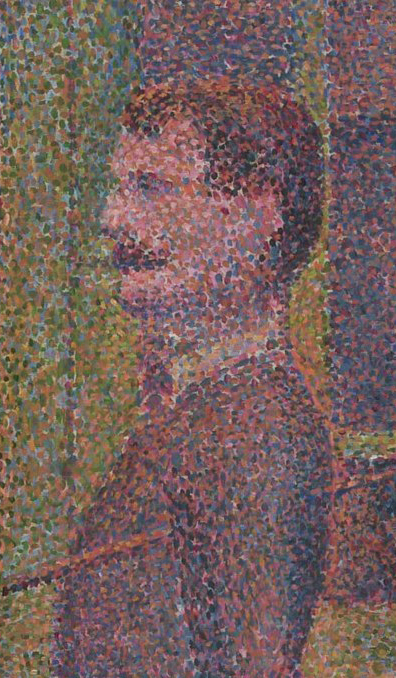
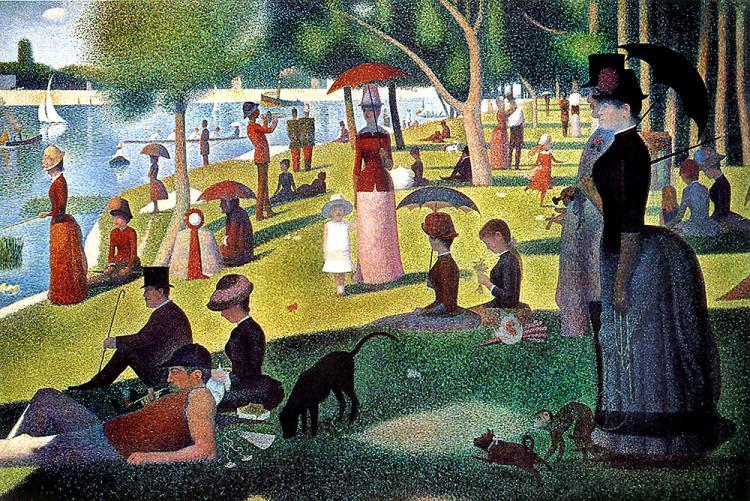
One of my favorite artists, Georges-Pierre Seurat, gained his ranking in my personal world through a technique he worked to perfect: pointillism. Think of it: the challenge to create an image through the use of nothing other than specks of color. While we, in our techno-savvy age, think nothing of computer-graphics-generated pixels or the wonders of electron-microscopy, for a late 19th century thinker, this was a creative challenge.


I used to think Seurat did this owing to his artistic genius. Just recently I discovered that he drew upon scientific theory in formulating the basis for his approach. The idea was that, rather than buy pre-blended paints, or even blend primary-colored pigments to create the desired image, the artist could achieve the same effect by juxtaposing various spurts of vibrant color on the canvas. There was one thing needed, though, to complete the equation: a gap between the object (the painting) and the beholder (me, standing about ten feet away from the display at the Art Institute of Chicago).


Demonstrating the effect by including a thumbnail sketch here would be impossible, because it would be only a photograph seen up close, defeating the purpose of the missing element, The Gap. But I’ll show it anyway. Here, you see a less-than-subtle demonstration of the technique in La Parade. Every speck of color is readily visible—though you can still allow that, though the discreet daubs of paint are obvious, the intended image is also clearly represented.


My favorite piece, Sunday Afternoon on the Island of La Grande Jatte, displays a more subtle application of the technique. I look at that and stand amazed that someone could achieve an entire snapshot of life in 1880s France using only dots of paint.

And that’s the point about Points: you can’t really have a point without a gap. And you can’t really know your Gap without its orienting points. Life is really about what’s happening in the spaces between the points. More than that, it’s what’s happening in the eye of the beholder that influences what’s happening in the spaces between the points. In other words, The Gap is really what I do with the Points I’ve been given in life. If I understand how that works—the relationships, the conferring of natures upon adjacent spaces, the blending of efforts and influences—then I can achieve something of worth in my Gap.

Wednesday, August 20, 2008

The Gap

In a society that values goal-oriented, time-managed living, one of the most fearsome circumstances to find ourselves in is The Place Between—between projects, between assignments, between jobs. A professor once mentioned to me that, soon after students receive their research assignments, they experience the stage of “milling about,” an aimless, listless time before the “Aha!” light bulb ignites to lift imagination out of the doldrums. Without the energy of discovery propelling us forward, The Place Between, the place of The Gap—that undefined element—can risk morphing into the mind’s bottomless pit.

While our natural tendency is to shun gaps, face it: gaps are where the action really happens. On the surface, The Place Between may suggest a listless existence, but under the placid surface, multiple possibilities are churning, strands of thought flying off in every direction.


A gap can be the space between two points where energy flows from the negatively-charged bottom of the clouds to the positively-charged segment of earth about to receive a brilliant lightning strike. It mimics that miniscule cleft between two communicating links in the nervous system that provides our bodies the ability to function in miraculous ways. In short, The Gap becomes the frontier between what we’re leaving behind and the possibilities we hope to achieve. That frontier is where the action whips up.


How scary can that be?


A gap can be an icon of connectivity…or at least the potential of relationship. The uncertainty really becomes what we make of it. And it’s driven by what we understand of the Point we’ve left behind, and what we perceive of the Point we hope to find.


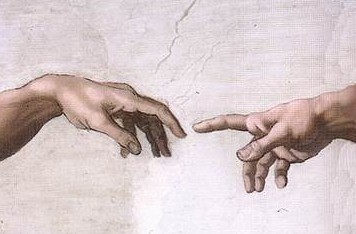
In one of the most poignant visual representations of the crucial aspect of The Gap, Michelangelo encapsulated the whole of the relationship potential between God and Man in one simple gesture. In the artist’s Sistine Chapel ceiling fresco, “Creation of Adam,” the now-famous space between the finger of Adam and the finger of God holds the captivating potential of mystery. Why aren’t the fingers touching? What is going on in the in-between place?


Connectivity sometimes puzzles me. Two people can have a relationship—can even be in the same room—yet be in completely different worlds. We can reach out and touch somebody, but did we really connect? What allows the connection to take hold?


The other day, Chris and I went to the hospital to visit a fellow homeschooling mom who suddenly and seriously found herself engulfed with cancer. She looked so different, so small, lying on the bed in her darkened room, undergoing chemo as we spoke. The pain of nights without sleep showed in the deep blues encircling her eyes. We came there, theoretically, to pray for her and encourage her. But can any of those mere words uttered make the connection that matters? She was in a bed not two steps away from me, but even if I reached to take her hand, could I really bridge The Gap? The Point A vignettes I knew her in for so many years now gave way to a gap between the Nice-Life known and an unknown Point B. How does one really speak to Point B when one hasn’t yet negotiated The Gap?


Crossing The Gap means making a difference. The Gap is outlined by Point A, sometimes also by Point B—but we can never, really, actually define The Gap as we move into it. We can point it out, demonstrate it, feel real feelings as we cross it, but we can’t explain the frontier. If we could, it would stop being a frontier. We would then have made the difference, have converted the potential into the knowable. Until it is known, it is fearsome. It represents a crisis, yet, it becomes our challenge.


What to make of The Gap?

Related Posts Plugin for WordPress, Blogger...