“Just about everyone who calls himself a conservative…is more grateful for what works in our world than angry about what doesn’t.”
—Yuval Levin,
“Back to Basics, Ahead to Particulars,”
in National Review, 1 December, 2008
“Just about everyone who calls himself a conservative…is more grateful for what works in our world than angry about what doesn’t.”
—Yuval Levin,
“Back to Basics, Ahead to Particulars,”
in National Review, 1 December, 2008
Young people’s reaction to the recent
Reading such comments as those on loops my daughter frequents online, I’ve wanted to break into the dialog with a Mom Moment and nurse these plebes back to hope.
I want to tell them: The war is not over—why, it’s barely begun. Rather than tuck tail and run, whining about the life they now would never get to have, they need to see they have a life, and this is it! Let it be added that it will not be a boring life.
Boring: isn’t that the number-one complaint of the young life? Challenge and difficulty definitely alleviate boredom, though that is seldom the requested substitute for ennui. The uneventful day has never been one to write home about (well, not until our current culture, the Now Generation Pluperfect, the one “All About Me”). News has always been about battles, conquests, victories—not how nice one’s humdrum existence might be.
Accomplishments have never been achieved lying on the proverbial bed of roses. Struggle means exertion, the chance to fail—but it also means the entrée to fuller, richer life: real life. Crisis takes from what little we do possess and shapes it into something worth having. Crisis molds the tools to succeed.
Crisis calls us to get with it and develop our basic aptitudes—not as in schooling, where the main thing was to resist learning—but with alacrity: hurry up, or else! Without crisis calling them out, latent qualities remain invisible. Rather than respond now with despondence, turbulent skirmishes of our 50-50 culture clash should call out those gifts. So my Mom Moment for the young says: be encouraged, don’t give up, engage in the battle. Do conquests.
Hearing this come out of my own mouth, I’m embarrassed to think of how I see my own gaps right now. Sometimes I feel like I’m adrift in my own personal Sargasso Sea, all awash with binding, slimy seaweed. I see no defining shores. I feel no call to action. I feel like Life Wasting Away. I can’t believe advice out of my own mouth for others could be just the prescription for my own life!
Emptying from one Gap into another. Still no defining points of reference. Only a cipher.
And yet we worked so hard…
Blog busted!
With ever the highest of intentions, this blogger wanted to be eyes for those who couldn't come along for the ride. On the fringes of my outer-spacey blogging experience, though, I haven't yet learned to predict the outcome of passing my Event Horizon—the Niagara Falls of Black Holes. Clue: once passing this point, there is no turning back. What's left behind may seem like silence. What's ahead—well, whole new worlds are screaming for consideration.
Present freshness wilts in passage.
And that's how I didn't post the rest of the homeschool conference our family attended on turf very different from our own. Now that my blogging fingers have been burnt, I've learned a few practical lessons.
First, always ensure before the weekend that the wi-fi connection we're planning on using is indeed available to all on campus.
Second, never underestimate the effect of hotel beds, salty take-out food, and long-term sitting-room-only compartments on one's ability to blog cogently. Travel-weary blogging: indeed insipid.
Third, don't plan on sequestering oneself with a laptop during events for which one traveled miles for the express purpose of networking. Or, note to self: those who cannot walk and chew gum at the same time should not attempt talking and blogging simultaneously!
It would be fair to say I've learned not to make extravagant promises, but I still feel the compulsion to promise to post what notes I had taken. I guess I'm the consummate sucker for keeping obligations. But, having passed the Event Horizon, there really is no turning back. Ahead loom so many new worlds.
Our culture gives lip service to the cliché, “It’s the journey, not the destination,” but drives its definition of success via “points.” There are Good Points and there are Bad Points. There is the Point of Departure—as long as it gracefully digresses from the linear parameters of “From Point A to Point B.” There is even the forbidden Point of No Return.
I have a lot of trouble dealing with Points. On the one hand, I am very goal-oriented, so I’m the one everyone has to shake and remind to enjoy the journey; I’m too concerned that we get to Point B by the appointed time. On the other hand, too many points stacked up nicely in a row define a line, and four of those, tied together just right form a box, and I never like to be put in a box, so why doom myself to self-containment by having the ingredients lying handily nearby? (Look, if I’m in a box—maybe even if I know I’m in a box—don’t be the first to tell me; I really resent it.) (On the other hand, do tell me; I need to know, so I can plan my escape.)
So, OK, that convinces me: Points are Good. And how does that convince me? Points define gaps. If there were no Points, there would be no Gaps to define. And, evidently, I need to be in a Gap right now, not a box. I need to find a way to immerse myself in my fear, my moment of being lost in The Gap. I can’t discover The Gap if I can’t find the points that outline it. I can’t define which gap I’m in until I know it’s the one between Point A and Point B.
There’s something more than definition, though. Point A and Point B actually lend flavor to their own gap. In other words, the gap between Point A and Point B is incredibly different than the gap between Point X and Point Y might be. The Points lend their influence to their in-between places.
One of my favorite artists, Georges-Pierre Seurat, gained his ranking in my personal world through a technique he worked to perfect: pointillism. Think of it: the challenge to create an image through the use of nothing other than specks of color. While we, in our techno-savvy age, think nothing of computer-graphics-generated pixels or the wonders of electron-microscopy, for a late 19th century thinker, this was a creative challenge.
I used to think Seurat did this owing to his artistic genius. Just recently I discovered that he drew upon scientific theory in formulating the basis for his approach. The idea was that, rather than buy pre-blended paints, or even blend primary-colored pigments to create the desired image, the artist could achieve the same effect by juxtaposing various spurts of vibrant color on the canvas. There was one thing needed, though, to complete the equation: a gap between the object (the painting) and the beholder (me, standing about ten feet away from the display at the Art Institute of Chicago).
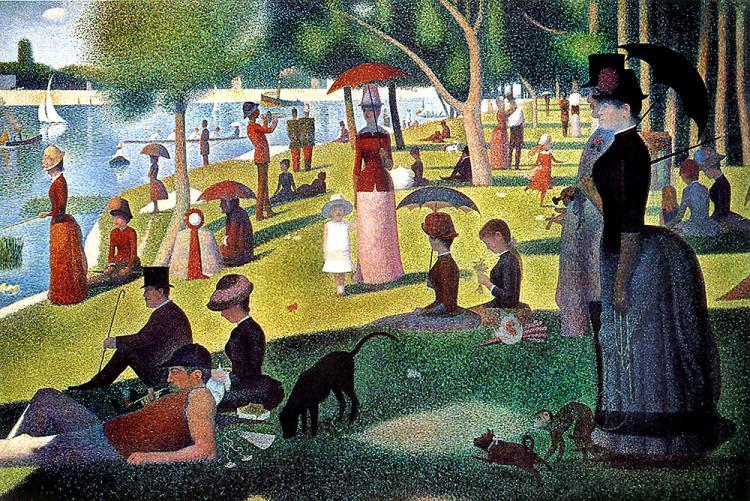
And that’s the point about Points: you can’t really have a point without a gap. And you can’t really know your Gap without its orienting points. Life is really about what’s happening in the spaces between the points. More than that, it’s what’s happening in the eye of the beholder that influences what’s happening in the spaces between the points. In other words, The Gap is really what I do with the Points I’ve been given in life. If I understand how that works—the relationships, the conferring of natures upon adjacent spaces, the blending of efforts and influences—then I can achieve something of worth in my Gap.
 In a society that values goal-oriented, time-managed living, one of the most fearsome circumstances to find ourselves in is The Place Between—between projects, between assignments, between jobs. A professor once mentioned to me that, soon after students receive their research assignments, they experience the stage of “milling about,” an aimless, listless time before the “Aha!” light bulb ignites to lift imagination out of the doldrums. Without the energy of discovery propelling us forward, The Place Between, the place of The Gap—that undefined element—can risk morphing into the mind’s bottomless pit.
While our natural tendency is to shun gaps, face it: gaps are where the action really happens. On the surface, The Place Between may suggest a listless existence, but under the placid surface, multiple possibilities are churning, strands of thought flying off in every direction.
A gap can be the space between two points where energy flows from the negatively-charged bottom of the clouds to the positively-charged segment of earth about to receive a brilliant lightning strike. It mimics that miniscule cleft between two communicating links in the nervous system that provides our bodies the ability to function in miraculous ways. In short, The Gap becomes the frontier between what we’re leaving behind and the possibilities we hope to achieve. That frontier is where the action whips up.
How scary can that be?
A gap can be an icon of connectivity…or at least the potential of relationship. The uncertainty really becomes what we make of it. And it’s driven by what we understand of the Point we’ve left behind, and what we perceive of the Point we hope to find.
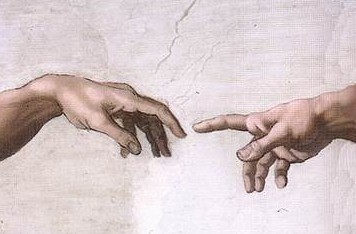
In one of the most poignant visual representations of the crucial aspect of The Gap, Michelangelo encapsulated the whole of the relationship potential between God and Man in one simple gesture. In the artist’s Sistine Chapel ceiling fresco, “Creation of Adam,” the now-famous space between the finger of Adam and the finger of God holds the captivating potential of mystery. Why aren’t the fingers touching? What is going on in the in-between place?
Connectivity sometimes puzzles me. Two people can have a relationship—can even be in the same room—yet be in completely different worlds. We can reach out and touch somebody, but did we really connect? What allows the connection to take hold?
The other day, Chris and I went to the hospital to visit a fellow homeschooling mom who suddenly and seriously found herself engulfed with cancer. She looked so different, so small, lying on the bed in her darkened room, undergoing chemo as we spoke. The pain of nights without sleep showed in the deep blues encircling her eyes. We came there, theoretically, to pray for her and encourage her. But can any of those mere words uttered make the connection that matters? She was in a bed not two steps away from me, but even if I reached to take her hand, could I really bridge The Gap? The Point A vignettes I knew her in for so many years now gave way to a gap between the Nice-Life known and an unknown Point B. How does one really speak to Point B when one hasn’t yet negotiated The Gap?
Crossing The Gap means making a difference. The Gap is outlined by Point A, sometimes also by Point B—but we can never, really, actually define The Gap as we move into it. We can point it out, demonstrate it, feel real feelings as we cross it, but we can’t explain the frontier. If we could, it would stop being a frontier. We would then have made the difference, have converted the potential into the knowable. Until it is known, it is fearsome. It represents a crisis, yet, it becomes our challenge.
What to make of The Gap?