Showing posts with label The Point. Show all posts

Wednesday, March 9, 2011

The Four Hundred Year Test

Mid-terms.

Final exams.

No matter what bull-dog determination students grab to wrestle through their testing seasons, there is no resilience to compare with a test of a very different sort, one I learned from the traditional American Thanksgiving saga. This is the test I have come to call the Four Hundred Year Test.

We all know about the fabled pilgrims who, buffeted in England for their faith, journeyed first to Holland, and then finally to the “New World” to seek religious freedom. On their ship to America in 1620, their faith and resolve were tested with all the rigors of primitive ocean-crossing travel of that time. Blown off course, their tiny vessel, the Mayflower, brought them to an inhospitable rocky coast where they were forced to winter. The hardship of New England weather coupled with the ravages of disease and near-starvation made it a miracle that any of the little band of travelers survived at all. We owe them much for their desire for God’s direction in all they did. The foresight to anchor their every act in His Word gave our nation the foundation that has made it the strong, blessed “harbor” for freedom that it still is today.

It wasn’t until my daughter stumbled upon those ubiquitous Dear America stories that the well-worn Pilgrim tale took on flesh and bones for me. Patience, the character from whose fictitious pen the narrative unfolds, was reflecting on her personal dilemma. On the ship whose uncertain voyage literally held the fate of her family’s survival, what little confidence she had began to dwindle. Such a price her family had paid—and all the other voyagers—that she mused whether it was worth the effort. They had all put so much into the voyage—not only into the voyage but into their entire lives—to obtain that elusive goal of being able to worship their Lord in the way of their convictions. Would all these hardships just be dashed upon some allegorical rocks and sink them into oblivion in that raging ocean? Would their convictions ever count for anything? She wondered if all their efforts would even be so much as remembered in a hundred years. Would her family’s simple day-to-day choices make any difference at all in the future?

It was from that plaintive entry in a fictional diary that a flesh-and-blood picture sprang up in my mind and took on the form of a rallying cry—a call to arms for a mission much broader than any five-year goal or ten-year plan. It painted a picture in my mind of a mission bigger than life—my life, at least. It stood as a rock-solid reminder that we don’t live for ourselves, that our actions have repercussions that reach far beyond our own life span. Those Pilgrim families chose a path whose impact has echoed through nearly four hundred years of history, and has set the foundation for a powerful government with international influence.

Can what I do in my lifetime pass a four hundred year test?

I am often dismayed to read articles and letters regarding people who agonize over whether they should continue the difficult course they have chosen for their betterment or for the benefit of their family. Perhaps these thoughts come from losing the insight that brought them to their decisions in the first place. Just like Patience in the Mayflower, blown off course in the midst of the stormy Atlantic, these people have lost the vision of what they are really doing. We think we are only attempting high goals for ourselves. But we are doing so much more! What we do may possibly provide future generations with an invincible foundation rooted in God’s ways—just like the Pilgrims—that will provide them with Life that will make a difference in more than just one life span.

While our nation is chipping away at the very bedrock truth that once made it great, conscientious parents and their families are going against that tide, seeking to provide a new generation with the resilience it will take to once again find that New World—and pass it on. We still hold these truths to be self-evident, and are determined to make them part of our lives in everything we do. We want to train up our children in the way they should go, to take on the whole armor of faith, and arm themselves for effective “battle.” But the battle does get weary when we set our sites on a target close at hand.

Instead of aiming for the target of “getting through this year” or even the target of graduation to another stage of life, let’s aim for a different target—the target of knowing that our arrows will make a difference in generations to come. As we set sail into each new endeavor, consider those whom your goals, once achieved, will benefit. Remember the Four Hundred Year Test.

Friday, April 10, 2009

What's so good about Good Friday?

Twenty-two hours ago—Facebook is good for those kinds of details—Sara posted a plea: “Please pray for Captain Richard Phillips and those who are trying to rescue him from pirates off the coast of Somalia.” Her heartfelt note included a link, helpful for uninformed people like me who are not reckoned with the average American news junkie.

Despite having Drudge, our homepage, blaring out constant updates, I had been avoiding exposure to the drama’s details. However, who could refuse Sara’s request? So I took a look to see what I should be praying about.

Pirates do not amuse me. Even at the height of the “Pirates of the Caribbean” craze, I was not amused. I never even took a look—though a culture infused with pirate-mania meant I could never fully escape awareness. In real life, pirates are not entertaining in the least. They are as serious as dead meat.

To read through the myriad details of this week’s crisis-in-real-life, there is no Jack Sparrow levity to lighten the load of negotiators or stategists. Frankly, I scanned through articles, avoiding the many quotes of persons “not authorized to talk.” The too-even-handed coverage giving dignity to lawless “spokespersons” discussing the needs of their “colleagues” is annoying.

One thing that captured my heart, though, was the mention of the captain of the ship, himself. Captain Richard Phillips, after ordering his crew to lock themselves in a safe room to avoid initial contact with the trespassing pirates, chose to surrender himself to the attackers to safeguard his crew. Taking their hostage with them, the Somali pirates fled to a lifeboat.

“That is what he would do. It's just who he is,” maintained his sister-in-law. It was a matter of character.

The ship itself echoed that character. Reports of the crisis note that it is unusual to find an American ship with an American crew in these waters—noting this was the first pirate attack on such an American vessel in countless years. Unusual it might be, until one realizes the purpose of the vessel: to carry food to malnourished people in the very country of the pirates’ origin.

Reading all this news on the eve of a significant Holy Week event, I couldn’t help thinking of parallels: the captain of his ship offering himself up to captors, his life held in exchange for ransom. The willingness of one man to substitute his life for that of others. The ship itself, designed to help the very people who turn against its commander.

Although I have been raised in a Christian home, I never understood—could never receive the full impact of realizing—the concept of a substitutionary death like the one held in annual remembrance on Good Friday. “Oh, look how Jesus Christ suffered,” church people would say, as if the misery of suffering itself would cause a change in me. While I am sorry that others suffer—especially when it is represented as if they have to suffer—I can’t seem to understand how that should somehow change my heart condition.

It was only when I could see the reason for a substitution—that that death should have been mine—that I could understand the importance of what happened that particular Friday two millennia ago. To see that there is a God who owns, by virtue of His creation, this world and all in it (which includes me), allows me to understand that the Creator has vested rights for organizing His creation in the way He sees fit. When His order is violated, justice expects payment. This Creator clearly stated that those who violate His order will die. Along with everyone else who has ever made a mistake, that includes me.

But God never intended it to end that way. He had a plan: to substitute a perfect being for me—for you, for “whosoever will”—so that the death I was sentenced to is not suffered by me, but by that other Person. For my own violations, I was being held for ransom, but He paid the price. It is not the horribleness of any suffering that changes my heart, but the intense gratitude for knowing that someone cared enough for me to do that—and was qualified to do so—that makes the difference.

While I pray earnestly for the voluntary captive in today’s shipping crisis, it reminds me of its coincidental placement on the schedule of another world: the time when the One who offered Himself to pay a ransom did so, that I might continue to live.

How can such miserable occurrences as these be called “good”? Perhaps the Somali pirate crisis for Captain Richard Phillips will never be called good—although I fervently hope he emerges a hero, and one who lives to see that recognition—but I know that the world’s captive sinners ransomed by Christ’s substitutionary death can now understand that Good Friday is good because One Man was willing to offer Himself to take the place of others who should have died.

Saturday, March 28, 2009

One Book to Make Time For

Picture this:


You have been unemployed for months. Just when you thought your house, car, and pet turtle were all going to be repo’ed by the evil bill collector, you are saved from your fate by unexpectedly landing a job. On your first day at work, your boss sidles over to you and tosses a floppy manual on your desk. “This covers everything you need to know to keep this job,” he advises. “Read it.”


Do you read it? Cover to cover?


OK, now try this one:


You are young, single, and now madly in love with the most wonderful person, who suddenly has to leave town for a compelling reason (let’s say cross-continental job transfer, or short-term missions trip, or to care for a close relative in a health crisis). Weeks pass and you find that “tweets” are not the next best thing to being there. The absence is becoming unbearable to you, when one day, you open your mailbox and find a thick envelope stuffed with several hand-written pages from the very one you are missing so much.


Do you read it? Word for word?


What about this:


You lose someone you love very much—an older, respected family member who has been your closest mentor, maybe a parent or grandparent—and while you are still in mourning, one of your siblings or cousins mentions finding this wonderful stash of material—private notes, journals, scrapbooks. Your loved one evidently not only meticulously kept a journal over the years, but also turned out to be one of those unobtrusive millionaires-next-door. Today, the family is gathering to read what has been left behind. You get the chance to see what you really meant to the one who mattered so much to you.


Do you read it? Do you look for your name?


What books feed your life?


Leviticus. Tedious?


Song of Songs. Too mushy?


The Testaments. Too long?


I find it incredible that there are people who consider themselves Christians but have yet to take the opportunity to read—cover to cover—the very volume that provides them direction in the duties of Life, inspiration from the One who Loves them, and riches from the last will and Testament that is their legacy.

Wednesday, January 28, 2009

His Little Life

It all started with an animal rescue mission gone awry. Our previous dynasty of cats no longer ruled the mouse-ridden turf outside our abbreviated country estate. To save ourselves, we needed a renewed feline presence.

“Dad,” our Darling Daughter intoned in her best darling daughter voice, “could we get a kitten?”

It just so happened, at that time, a feral outcast skulking around the outbuildings at her dad’s work—the county jail—had given birth to a brood of kittens. To save the pitiful urchins from a destiny akin to their mother’s, a secretary in Chris’s office had arranged to have them captured and brought to her home, to nurture (which included frequent bottle-feedings), tame from the wild, and of course, ultimately give away to good homes where in their adult lives they would be prevented from casting off future litters of feral cats.

In due time, we visited that cat-rescue center, where Darling Daughter managed to exit with not one, but two, kittens. Perhaps in a token nod to the location of the kittens’ birth, or perhaps in recognition of the line of duty of that workplace, one of the four kittens ended up being a black-and-white. Law enforcement being so closely intertwined with black-and-whites, it was not the last we were to see of that motif.

Life progressed admirably with the proper adoption and training of our two new residents. Once away from their humble origins, they took on the comely aura bestowed more by heritage than happenstance. Spoiled as only children, they had the aristocratic air of an Abyssinian, and commensurate with their newly-acquired lofty position they knew no common life. Shot histories immaculately recorded, visits to the vet dutifully kept—until one day at about six months, our vet kindly reminded us that it was time to think about having the little cherubs fixed.

“But they look so young, so small,” we thought to ourselves. “We’ll wait a while.”

“And wouldn’t it be fun to let them have one bunch of kittens?” our Darling Daughter intoned in her most darling daughter voice. After all, our property was best maintained at its mouse-free status with about eight cats. And Toes, the doddering spinster aunt from the last passel of cats, though still hanging on to her neurotic crotchety life, was well beyond hunting age. We could use the additional help.

Dad, predictably, caved.

And so, in good time, Tux and Macready each became proud moms with their own four kittens—kittens which, incidentally, Darling Daughter’s Dad fully intended to give away to good homes, just as had happened to their mothers before them. And, of course, once the moms fulfilled their duties of motherhood, it was to be off to the vet to insure this was the end of our cat procreation.

It took us until after we discovered one of the “babies” had birthed her own litter to realize that this breed of cat was genetically disposed to either tinyness or precociousness. At any rate, black-and-white Tux had given us, among others, black-and-white Waders, who quickly produced a runt litter of two more black-and-whites. The reproductive rodeo, as Chris dubbed it, was now in full swing.

Other than producing runts, you could say Waders had achieved the ideal family: one boy, one girl—except that there was something unexplainably wrong with the male. While the girl, Checkers, grew to be cute, perky, and irresistibly charming, the young boy seemed to be suffering from the feline version of “Failure to Thrive.”

One day, we accidentally noticed that his mom had actually rejected him. He was shunted off into a corner of the kennel, and she wasn’t nursing him. Ever the animal lover, our daughter bought equipment and formula to bottle-feed him. That earned her his eternal gratefulness, which he signaled by lawn-mower-loud purring every time he thought he’d be brought inside for another feeding. But it also became a manmade circumvention of Mother Nature’s brutal eugenics program, most commonly dubbed Natural Selection.

“I could so easily snap his little neck and save him from his suffering,” Chris observed one day. As we watched him grow, it daily become more painfully obvious that this little kitten had been the victim of inbreeding—a private curse he never asked for, but one which became his lot before he ever knew life.

By this point, we were discovering that the market for free kittens had dried up just as surely and concurrently as had the housing market. Meanwhile, our Reproductive Rodeo had yielded more cats than we could manage to name and we defaulted to generic descriptors. Since surely this little guy was not going to make it, though, we hadn’t bothered to name him.

Yet in his own pathetic little way, this kitten wormed his way into our hearts. One day, as we opened the kitchen door to the garage where we kept the kennels, our pitiful guy revved up his purr-motor and leapt up the step to charge into the kitchen. Our Sealyham Terrier, barging down the hallway from the opposite direction, met him in a near-head-on collision, and, as Sealyhams are genetically programmed to do in the chance meeting with a rat-sized object, nearly gulped the poor guy whole! We saved him from such a catastrophe, of course, but from that point, he was dubbed Tidbit.

It is horrible and mean-spirited to laugh at another’s handicaps, of course, but something about the pitiful but endearing Tidbit brought us great mirth as we watched his growing-up antics. Though he hardly could figure out how to exit the garage through the cat door, he did learn how to romp and play with the other cats sometime in the late summer, well beyond the time his age-mates had learned to do so. It was sweet to watch him discover the joy of running, especially in the grass. Something short-circuited in his brain, though, and he often would get stuck in tight loops, running in circles when he became anxious or excited. He’d become so excited at dinner time that he would run in circles until well after most of the other cats had finished eating. Of course, he never forgot the possibility of that wonderful time of bottle feeding, and the merest touch to the back of his head to pet him brought on gales of purring, and the loudest, most plaintive meows as he pled to be let inside for another treat.

One day, as Tidbit was still puzzling over getting the hang of using the cat door, unbeknownst to him, we had just pulled in the driveway and opened the garage door--the panel to which the cat door was affixed. Tidbit must have just convinced himself it was okay to put his front paws on the threshold of the cat door in preparation to exit, when, out of nowhere, the door began to lift…and lift…and lift. In our front-row car seats to this comedy, we saw the garage door move, and then a kitten begin to dangle from the uplifting panel—much in the manner of the “Hang In There Kitty” posters of years ago—and we couldn’t stop ourselves from laughing. Of course, we halted the door’s advance immediately, and went to tenderly—and carefully, as this poor creature was also incontinent—rescue Tidbit from his predicament.

As sorry as his life was—this is where the Quality of Life Cops demand the upper hand in pronouncements—it was a life, and we wanted to respect that. We did what we could to make his life comfortable, sweet, and manageable. And really, what are these little concessions in the face our own life’s demands? Giving him a cozy bed and a heating pad in the midst of winter’s cold snaps, or a nibble of something he deemed tasty, cost us little in the midst of all our competing schemata of Life. Life with Tidbit was not a zero-sum game. We did what we could for him, and it in no way deprived us of our own lives. On the contrary, Tidbit became one of those small blessings in life that enriched our own lives.

And so, as incredible as it may seem, when we returned last week from an out of town trip to find Tidbit stretched out lifeless on our garage floor, it warranted a wave of melancholy in seeing his passing.

He had his little life, we had always said. His little life. But it was a life—and that was what really mattered.

Tuesday, November 25, 2008

The Price of Nice

“‘The true aristocracy and the true proletariat of the world are both in understanding with tragedy. To them it is a fundamental principle of God and the key—the minor key—to existence. They differ in this way from the bourgeoisie of all classes, who deny tragedy, who will not tolerate it, and to whom the world of tragedy means itself unpleasantness.’


“Perhaps this is just the key we have lost. Suffering, even in its mildest forms—inconvenience, delay, disappointment, discomfort, or anything that is not in harmony with our whims and preferences—we will not tolerate. We even reject and deny it….


“Have we missed a fundamental principle of God? Is not suffering, loss, even death itself the minor key to existence? Do we not lose our very lives by trying so hard to save them?


“The words which have illuminated for me the deepest understanding of suffering are Jesus’ own, ‘In truth, in very truth I tell you, a grain of wheat remains a solitary grain unless it falls into the ground and dies; but if it dies, it bears a rich harvest.’ This, He told His disciples, was the key. There is a necessary link between suffering and glory.


—Elisabeth Elliot, in A Path Through Suffering, commenting on a quote from Isak Dinesen


Thursday, August 21, 2008

The Futility of Being Pointless

Our culture gives lip service to the cliché, “It’s the journey, not the destination,” but drives its definition of success via “points.” There are Good Points and there are Bad Points. There is the Point of Departure—as long as it gracefully digresses from the linear parameters of “From Point A to Point B.” There is even the forbidden Point of No Return.


I have a lot of trouble dealing with Points. On the one hand, I am very goal-oriented, so I’m the one everyone has to shake and remind to enjoy the journey; I’m too concerned that we get to Point B by the appointed time. On the other hand, too many points stacked up nicely in a row define a line, and four of those, tied together just right form a box, and I never like to be put in a box, so why doom myself to self-containment by having the ingredients lying handily nearby? (Look, if I’m in a box—maybe even if I know I’m in a box—don’t be the first to tell me; I really resent it.) (On the other hand, do tell me; I need to know, so I can plan my escape.)


So, OK, that convinces me: Points are Good. And how does that convince me? Points define gaps. If there were no Points, there would be no Gaps to define. And, evidently, I need to be in a Gap right now, not a box. I need to find a way to immerse myself in my fear, my moment of being lost in The Gap. I can’t discover The Gap if I can’t find the points that outline it. I can’t define which gap I’m in until I know it’s the one between Point A and Point B.


There’s something more than definition, though. Point A and Point B actually lend flavor to their own gap. In other words, the gap between Point A and Point B is incredibly different than the gap between Point X and Point Y might be. The Points lend their influence to their in-between places.


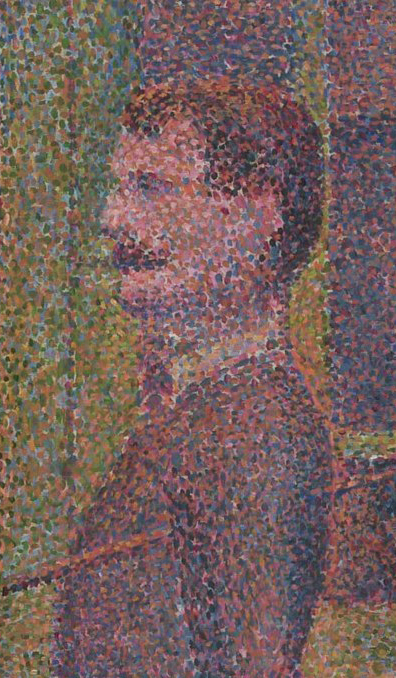
One of my favorite artists, Georges-Pierre Seurat, gained his ranking in my personal world through a technique he worked to perfect: pointillism. Think of it: the challenge to create an image through the use of nothing other than specks of color. While we, in our techno-savvy age, think nothing of computer-graphics-generated pixels or the wonders of electron-microscopy, for a late 19th century thinker, this was a creative challenge.


I used to think Seurat did this owing to his artistic genius. Just recently I discovered that he drew upon scientific theory in formulating the basis for his approach. The idea was that, rather than buy pre-blended paints, or even blend primary-colored pigments to create the desired image, the artist could achieve the same effect by juxtaposing various spurts of vibrant color on the canvas. There was one thing needed, though, to complete the equation: a gap between the object (the painting) and the beholder (me, standing about ten feet away from the display at the Art Institute of Chicago).


Demonstrating the effect by including a thumbnail sketch here would be impossible, because it would be only a photograph seen up close, defeating the purpose of the missing element, The Gap. But I’ll show it anyway. Here, you see a less-than-subtle demonstration of the technique in La Parade. Every speck of color is readily visible—though you can still allow that, though the discreet daubs of paint are obvious, the intended image is also clearly represented.


My favorite piece, Sunday Afternoon on the Island of La Grande Jatte, displays a more subtle application of the technique. I look at that and stand amazed that someone could achieve an entire snapshot of life in 1880s France using only dots of paint.

And that’s the point about Points: you can’t really have a point without a gap. And you can’t really know your Gap without its orienting points. Life is really about what’s happening in the spaces between the points. More than that, it’s what’s happening in the eye of the beholder that influences what’s happening in the spaces between the points. In other words, The Gap is really what I do with the Points I’ve been given in life. If I understand how that works—the relationships, the conferring of natures upon adjacent spaces, the blending of efforts and influences—then I can achieve something of worth in my Gap.

Related Posts Plugin for WordPress, Blogger...