 In a society that values goal-oriented, time-managed living, one of the most fearsome circumstances to find ourselves in is The Place Between—between projects, between assignments, between jobs. A professor once mentioned to me that, soon after students receive their research assignments, they experience the stage of “milling about,” an aimless, listless time before the “Aha!” light bulb ignites to lift imagination out of the doldrums. Without the energy of discovery propelling us forward, The Place Between, the place of The Gap—that undefined element—can risk morphing into the mind’s bottomless pit.
While our natural tendency is to shun gaps, face it: gaps are where the action really happens. On the surface, The Place Between may suggest a listless existence, but under the placid surface, multiple possibilities are churning, strands of thought flying off in every direction.
A gap can be the space between two points where energy flows from the negatively-charged bottom of the clouds to the positively-charged segment of earth about to receive a brilliant lightning strike. It mimics that miniscule cleft between two communicating links in the nervous system that provides our bodies the ability to function in miraculous ways. In short, The Gap becomes the frontier between what we’re leaving behind and the possibilities we hope to achieve. That frontier is where the action whips up.
How scary can that be?
A gap can be an icon of connectivity…or at least the potential of relationship. The uncertainty really becomes what we make of it. And it’s driven by what we understand of the Point we’ve left behind, and what we perceive of the Point we hope to find.
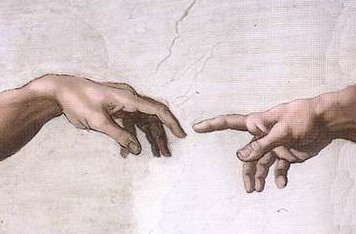
In one of the most poignant visual representations of the crucial aspect of The Gap, Michelangelo encapsulated the whole of the relationship potential between God and Man in one simple gesture. In the artist’s Sistine Chapel ceiling fresco, “Creation of Adam,” the now-famous space between the finger of Adam and the finger of God holds the captivating potential of mystery. Why aren’t the fingers touching? What is going on in the in-between place?
Connectivity sometimes puzzles me. Two people can have a relationship—can even be in the same room—yet be in completely different worlds. We can reach out and touch somebody, but did we really connect? What allows the connection to take hold?
The other day, Chris and I went to the hospital to visit a fellow homeschooling mom who suddenly and seriously found herself engulfed with cancer. She looked so different, so small, lying on the bed in her darkened room, undergoing chemo as we spoke. The pain of nights without sleep showed in the deep blues encircling her eyes. We came there, theoretically, to pray for her and encourage her. But can any of those mere words uttered make the connection that matters? She was in a bed not two steps away from me, but even if I reached to take her hand, could I really bridge The Gap? The Point A vignettes I knew her in for so many years now gave way to a gap between the Nice-Life known and an unknown Point B. How does one really speak to Point B when one hasn’t yet negotiated The Gap?
Crossing The Gap means making a difference. The Gap is outlined by Point A, sometimes also by Point B—but we can never, really, actually define The Gap as we move into it. We can point it out, demonstrate it, feel real feelings as we cross it, but we can’t explain the frontier. If we could, it would stop being a frontier. We would then have made the difference, have converted the potential into the knowable. Until it is known, it is fearsome. It represents a crisis, yet, it becomes our challenge.
What to make of The Gap?

